



























- AI Planning Made Easy: Our solutions integrate seamlessly with your existing ERP, MES or APS landscape. They deliver optimized and fully traceable planning results — without requiring in-house AI development. AI becomes a 24/7 partner, providing continuous support and taking pressure off your teams.
- Managing Complexity: Many combinatorial problems in production planning are too complex for traditional methods. With our approaches, even highly complex scenarios can be solved efficiently — automated and within the shortest possible time.
- Facts Over Gut Feelings: Mathematical optimization delivers reliable decisions — improved on-time delivery, reduced setup times, optimal warehouse utilization, and more. This leads not only to faster outcomes, but to demonstrably better results.

Our Solutions in Action
We address common challenges in production planning — from detailed scheduling and resource allocation to production leveling. Our algorithms not only generate entirely new production schedules, but also selectively improve existing, manually created plans.
Detailed Planning
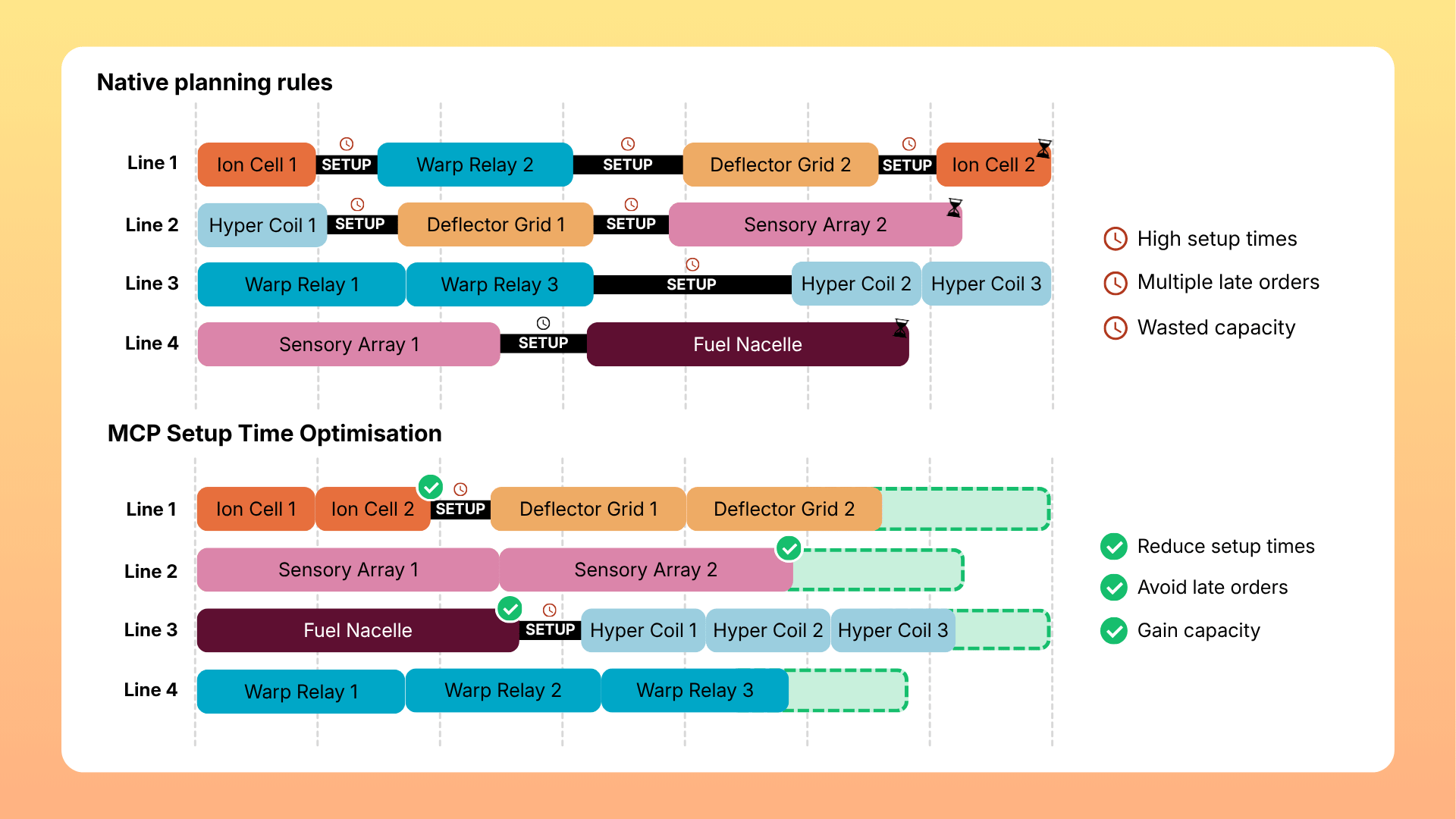
Setup Time Optimisation
Intelligent production scheduling for setup time optimized manufacturing. Business Impact:
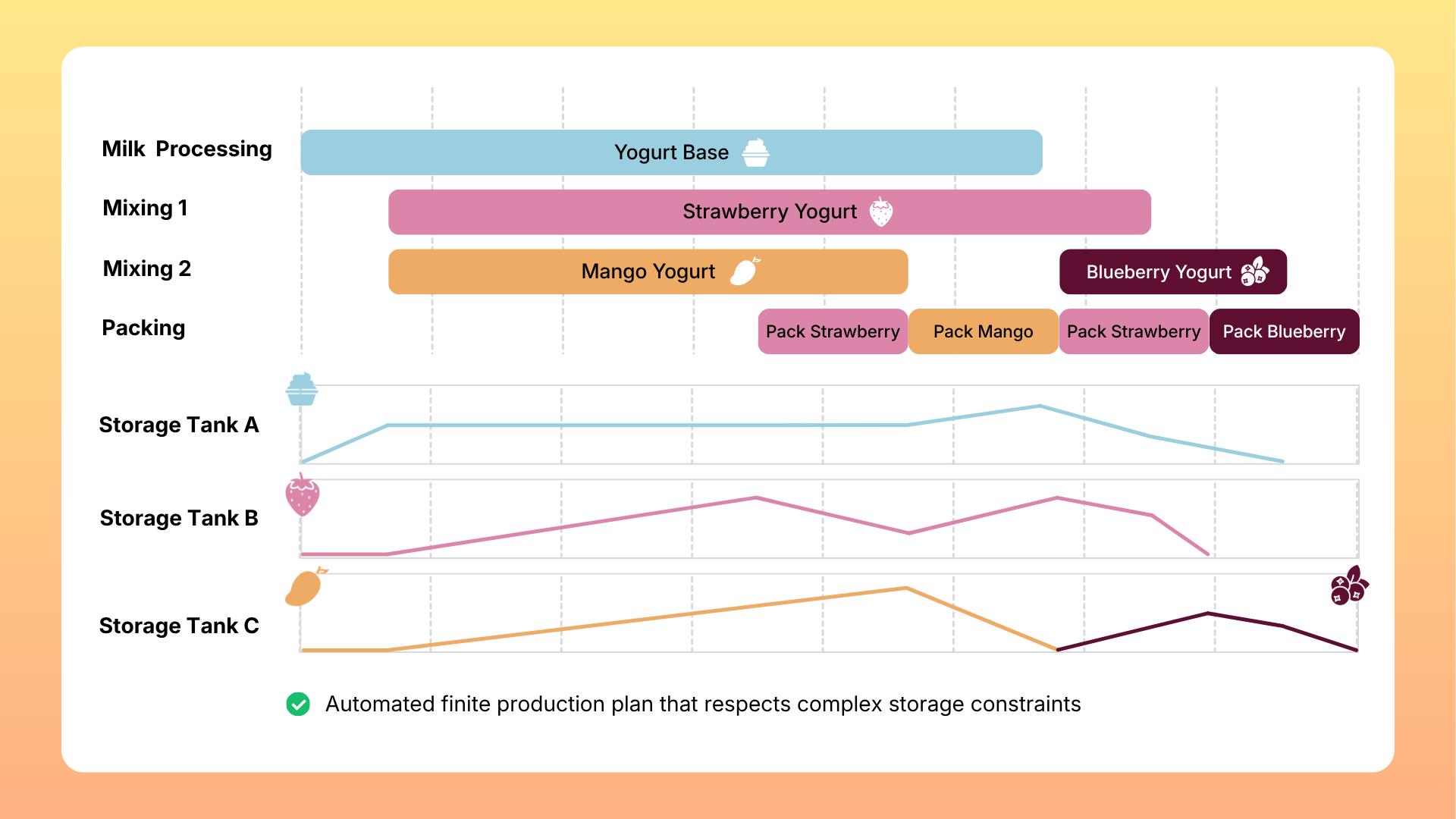
Food Production Scheduling
Automatic production planning for highly dynamic food and beverage manufacturing. Business Impact:
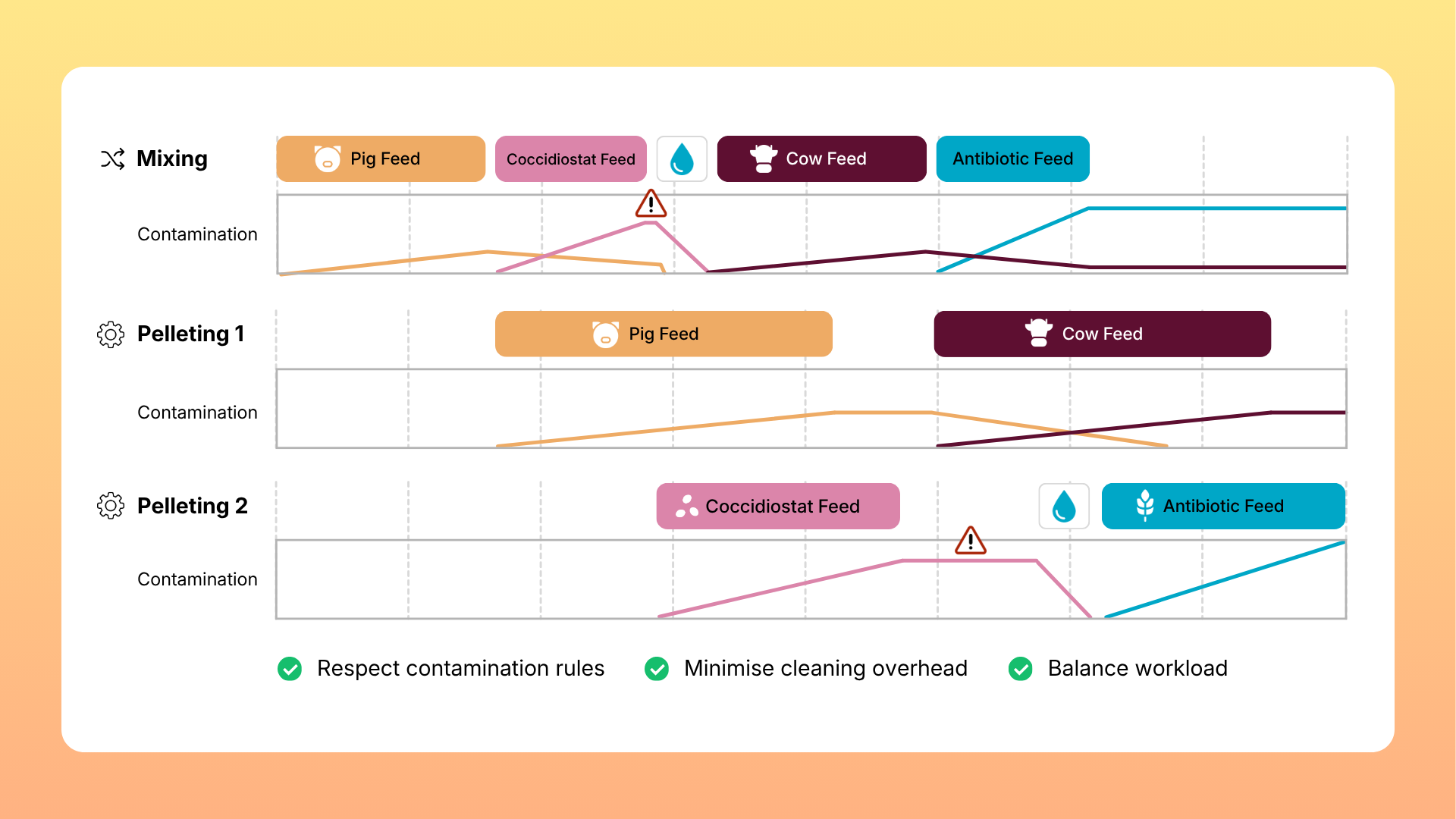
Process Industry Scheduling
Intelligent detailed scheduling for complex process industries with high interdependencies. Business Impact:
Paint Shop Scheduling
Efficient sequencing and campaign planning forcomplex painting systems. Business Impact:
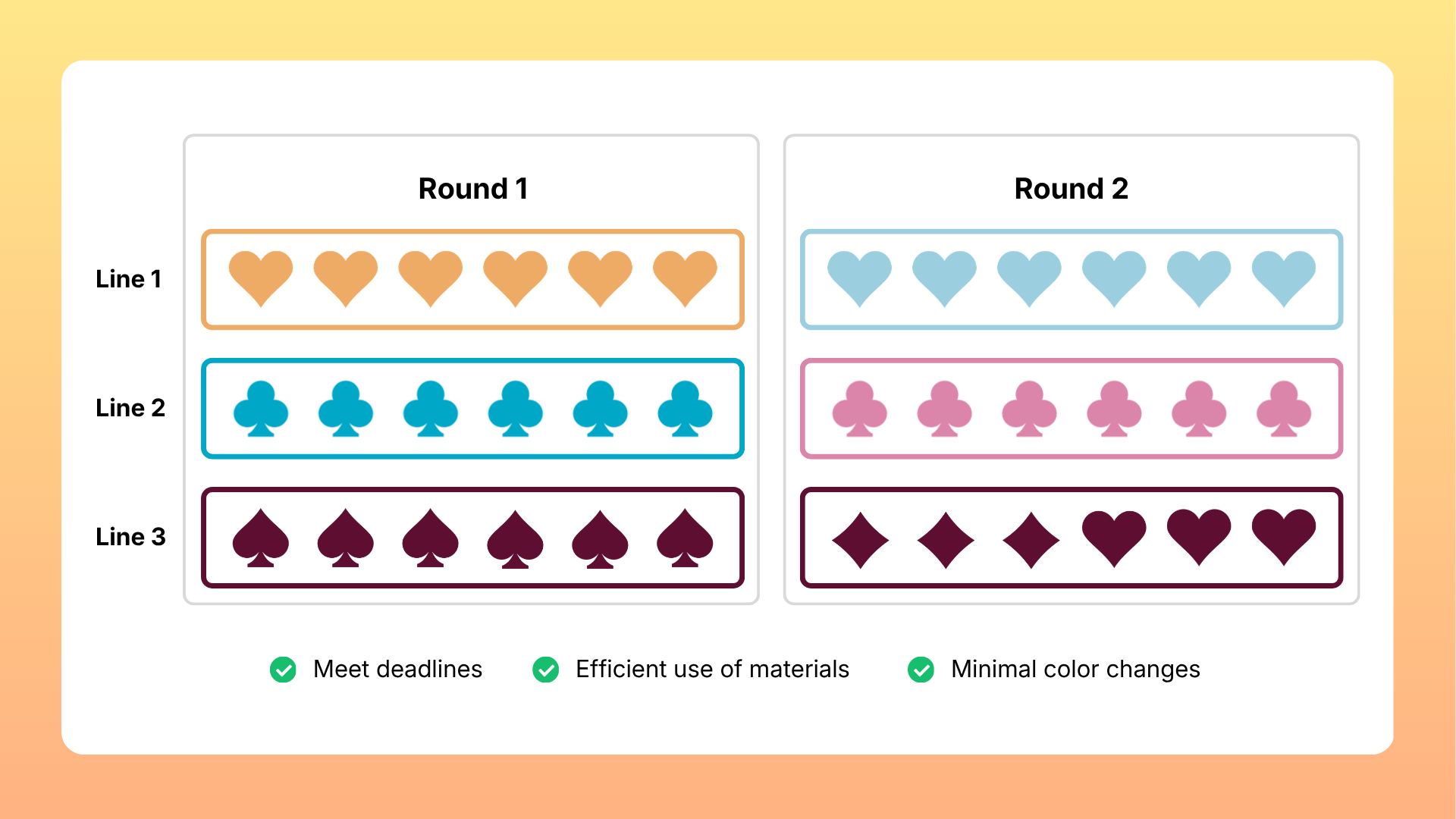
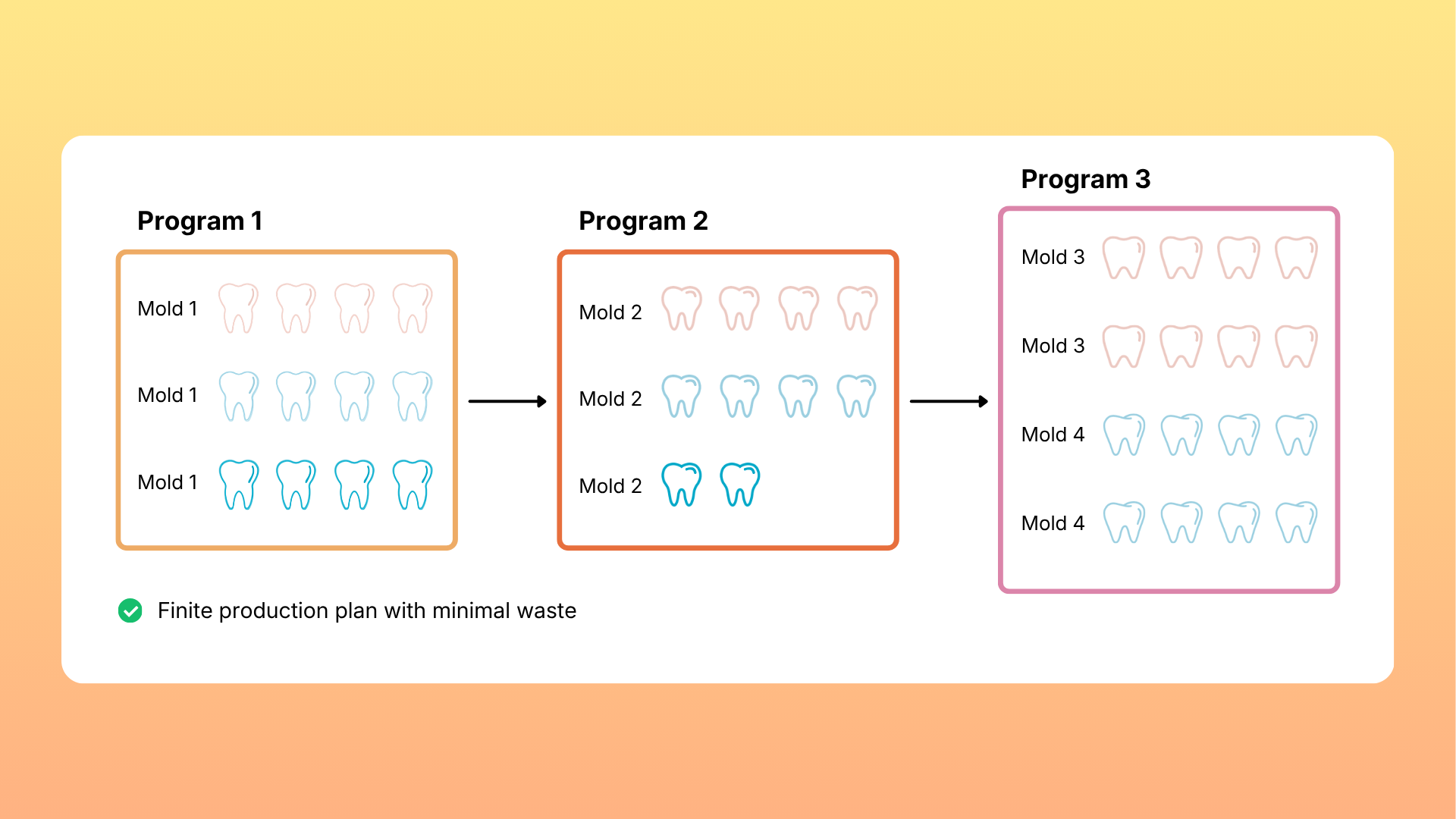
Artificial Teeth Scheduling
Optimised cyclic scheduling for highly variantproduction environments. Business Impact:
Resource Assignment
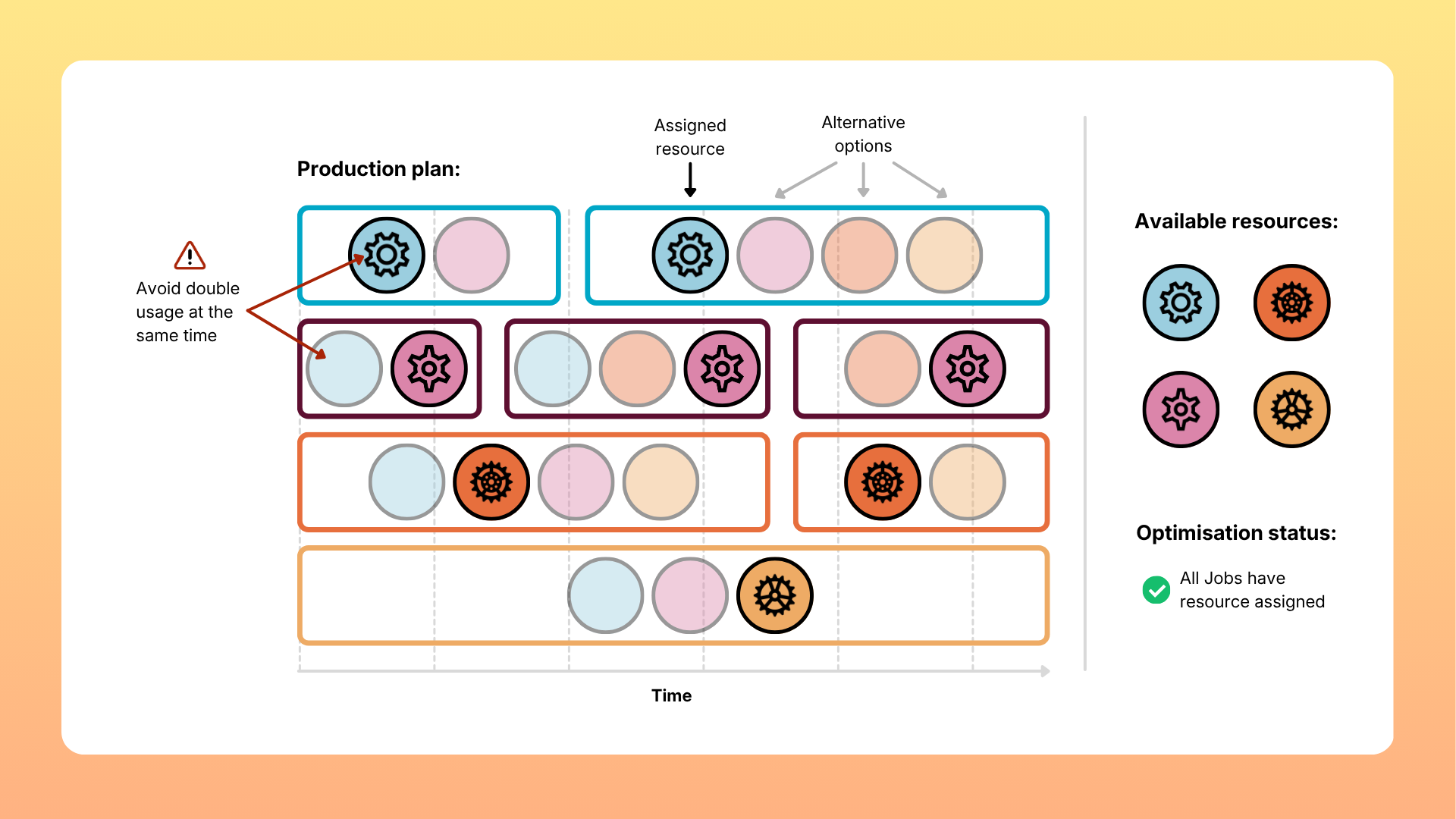
Core Resource Assignment
Automatic allocation of limited resources under complex constraints. Business Impact:
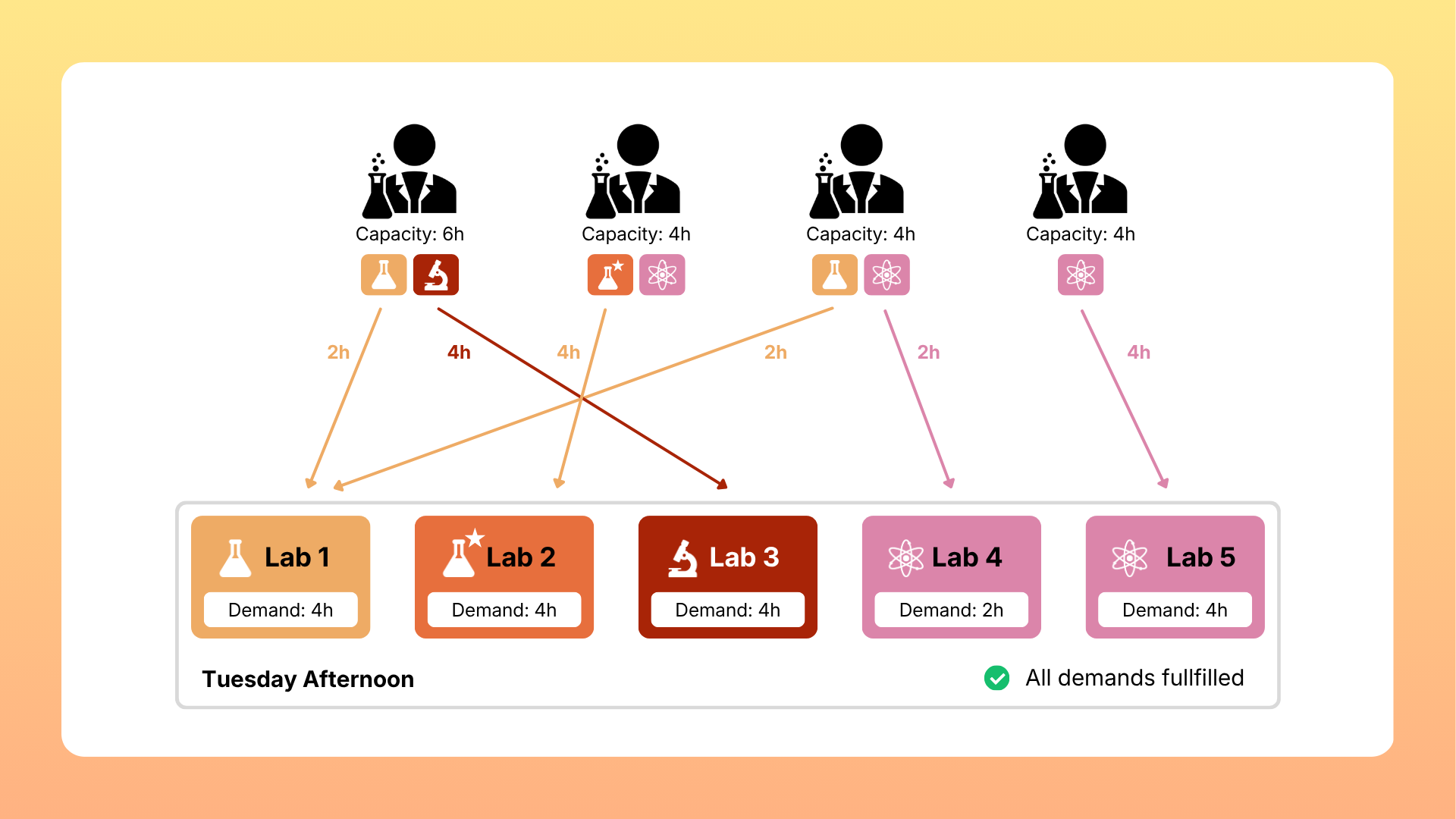
Employee Resource Assignment
Intelligent staff allocation based on qualifications and priorities. Business Impact:
From High-Level to Detailed Planning
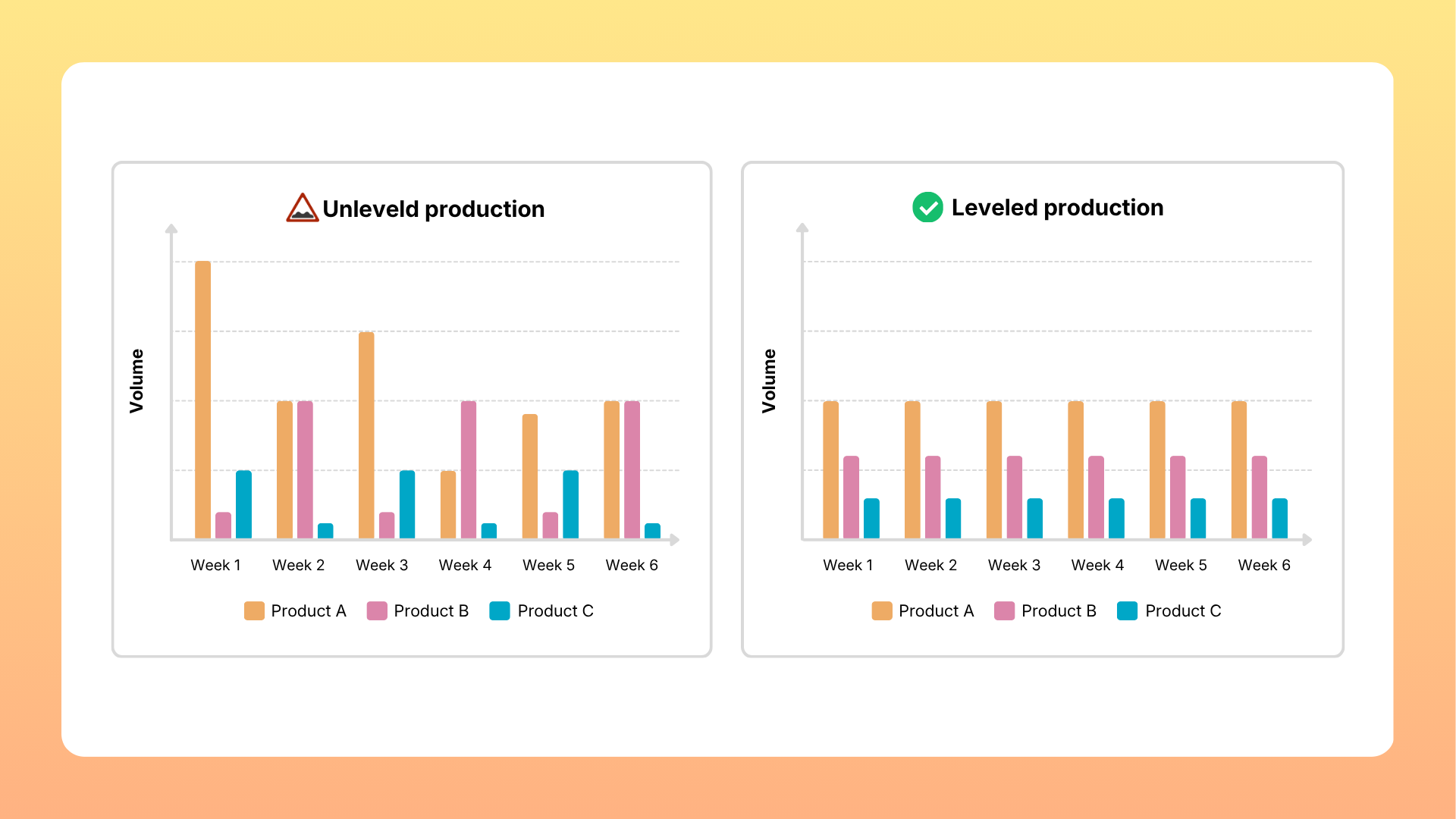
Production Leveling
Smoothing of production volumes to stabilizecapacity utilization and material flow. Business Impact:
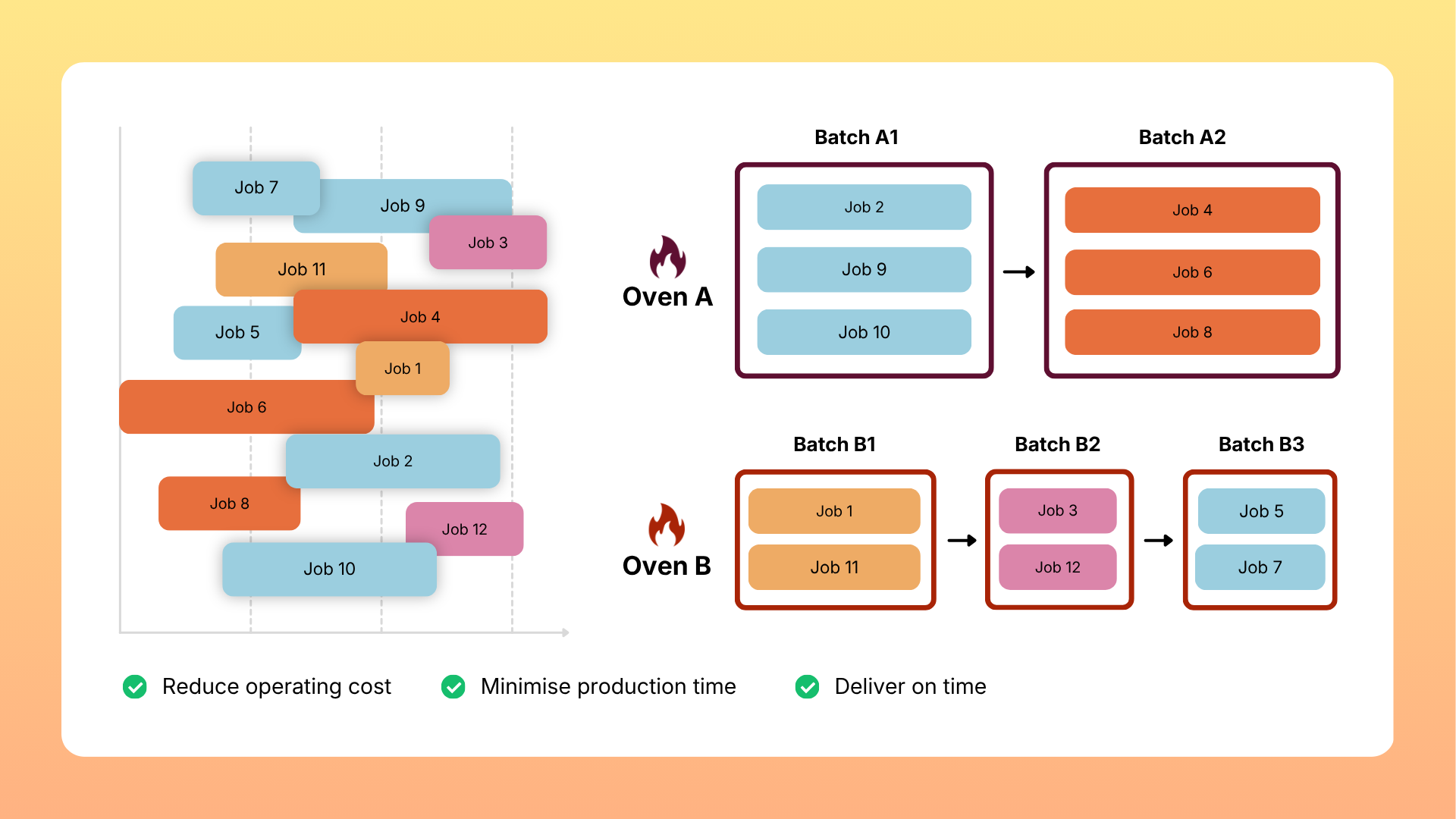
Batch Optimisation
Optimal batch creation for complex production requirements. Business Impact:
Interested in one of our optimisation solutions, or dealing with a different planning challenge?
Let’s talk and explore together what approach best fits your needs.
Optimisation across different production logics

Process Manufacturing
Focus
Continuous and process-oriented production with:
- Tank and silo logic
- Batch formation
- Recipes / formulations
- Sequence dependencies
- High degree of process interdependency
Typical industries:
- Food industry
- Beverage industry
- Chemical industry
- Pharmaceutical industry
- Ultra-fresh food
- Animal feed industry
- Pet food industry
- Cosmetics industry

High-Mix Manufacturing
Focus
Complex discrete manufacturing with:
- High product variety
- Resource and constraint challenges
- Complex material flows
- High decision-making complexity
- Dynamic detailed scheduling
Typical industries:
- Electronics industry
- Electrical engineering / machinery manufacturing

Setup & Flow Optimisation
Focus
Production environments with:
- High setup intensity
- Line and flow optimisation
- Sequence optimisation
- Campaign planning
- Throughput focus
Typical industries:
- Fast-moving consumer goods (FMCG)
- Consumer goods
- Building materials industry
- Printing industry
Easy Integration
AI …
- Mathematical Optimisation: Methods such as constraint programming and integer programming provide exact, transparent, and verifiable solutions—ideal for structured planning problems with clearly defined constraints.
- Metaheuristics: Methods such as simulated annealing efficiently explore large search spaces and offer a flexible alternative when classical methods reach their limits.
- Machine Learning: Algorithms that learn from data, adapt, and dynamically improve decision-making—complementing mathematical optimization with intelligent, data-driven support.
… as-a-Service
Our solutions integrate easily into your planning module—requiring only a simple interface setup. No complex projects, no extensive customisation.
- Input: Your planning data—such as orders, resources, and setup times—is transmitted to our AI via a REST API. The call can be integrated directly into your existing software.
- Optimisation: The AI processes the data and computes an optimized solution—quickly, reliably, and transparently. In the process, complex interdependencies are automatically taken into account.
- Output: The result is an optimised production plan returned via the API—ready for display, further processing, or transfer to downstream systems.
Comprehensive expertise
Through ongoing collaboration with scientific partners, the latest research findings are directly incorporated into our development—resulting in solutions that are technologically advanced and scientifically sound.

From 2017 to early 2025, our Christian Doppler Laboratory was hosted at the Institute for Logic and Computation at TU Vienna. Together with Bosch and Ximes, we conducted basic research on new algorithms and the application of AI in production planning. Since 2024, we have been funding a doctoral position at the iCAIML Doctoral College, allowing us to remain closely connected to research in areas such as hyperheuristics and automated algorithm selection.

Together with the Karlsruhe Institute of Technology (KIT), we conduct research into methods for enhancing the energy flexibility of industrial processes. The aim is to develop AI-supported approaches that make energy-intensive production more grid-friendly and sustainable. This collaboration brings together our long-standing expertise in APS with KIT’s cutting-edge research in energy system design. As an implementation partner, we transfer research results into industrial practice—for future-proof production.

Selected Research Areas
Stochastic modeling Capacity Planning

Selected Research Areas
Human Factors Industry 4.0 Decision Analysis Project Management
Science-based and proven in practice
Thanks to our many years of experience with numerous industrial projects, we know exactly what matters in production planning.We understand the specific requirements and typical challenges across many industries, from compound feed production to the food industry, and from cosmetics and pharmaceuticals to electronics manufacturing.Our solutions are field-proven, robust, and flexible enough to deliver real value in both complex production environments and in software products designed for these industries.




Successful Software Integrations
Optwisier A.I. Solutions’ modern supply chain planning software is powered by optimization algorithms from MCP.The solution enables automated detailed planning specifically for the food industry, including multi-stage processes that take setup times and intermediate storage capacities into account.

Our optimization technology integrates seamlessly with Siemens Opcenter APS.Whether for detailed planning or resource allocation, complex planning problems are solved directly within the existing system—efficiently and flexibly, with minimal effort for the user.

MCP Workforce Management utilizes the Employee Resource Assignment Algorithm.This ensures that the right people are in the right place at the right time—boosting efficiency as well as on-time performance and utilization.
GRÜN GQM uses MCP's AI-as-a-Service in its established MES software for the food and beverage industry.
Automatic line sequence optimization enables planners to improve existing schedules at the click of a button—resulting in shorter setup times and improved on-time delivery.For end customers, this means increased capacity in both production and planning.

Frequently asked questions about AI-as-a-Service
AI-as-a-Service is particularly valuable when existing planning systems no longer deliver stable or economically optimal results. This is typically the case when:
- production plans require frequent manual adjustments
- bottlenecks and conflicting objectives cannot be resolved systematically
- existing APS systems or rule-based approaches reach their limits under high complexity
In these situations, AI-driven optimization enables significant improvements in delivery reliability, resource utilization, and planning stability.
If these challenges are currently present, a structured potential assessment is the most effective next step.
AI‑as‑a‑Service is well suited for complex planning problems with many interdependencies, constraints, and conflicting objectives. Typical use cases include:
- production scheduling / detailed production planning
- setup time optimization
- resource allocation (machines, tools, workforce)
- production leveling and batch optimization
Wherever traditional planning approaches reach their limits, AI‑based optimization opens up new solution spaces.
Traditional heuristic rules make planning decisions sequentially and locally. In contrast, AI-based optimization evaluates the entire planning scenario at once and systematically considers interactions between resources, deadlines, and constraints.
The result:
- more stable production plans
- improved resource utilization
- reduced trade-offs and conflictshigher economic quality of planning
- higher economic quality of planning
Your Next Step Toward Optimised Production Planning with AI
In a structured discussion, we’ll analyze your planning challenges and show you how optimization algorithms can specifically enhance your existing systems and deliver measurable improvements.