



























Artificial intelligence is particularly well suited for planning requirements where multiple complex influencing factors must be considered simultaneously.While classical planning rules represent clearly defined priorities, AI enables the analysis of large combinatorial spaces and identifies optimization potential that rule‑based approaches can only capture to a limited extent.MCP develops and implements AI‑based planning logic specifically in areas where economic benefits can no longer be fully realized using conventional methods.

Typical use cases include:
Optimal workforce allocation
AI algorithms consider qualifications, availability, shift models, and productivity differences to optimally assign employees to existing production plans.
Optimal allocation of production resources
When multiple alternative assignment options exist, AI identifies the most economically viable resource allocation while taking bottlenecks into account.
Setup and cleaning optimization
AI analyzes complex setup matrices and process dependencies to generate sequences that further reduce changeover effort and downtime.
Optimal utilization of silos and tanks
Volumes, content restrictions, cleaning cycles, and process dependencies are evaluated simultaneously to efficiently manage allocations.
Energy costs
In furnace or cooling processes, AI optimizes batch composition to reduce machine runtimes while simultaneously ensuring output and on‑time delivery performance.
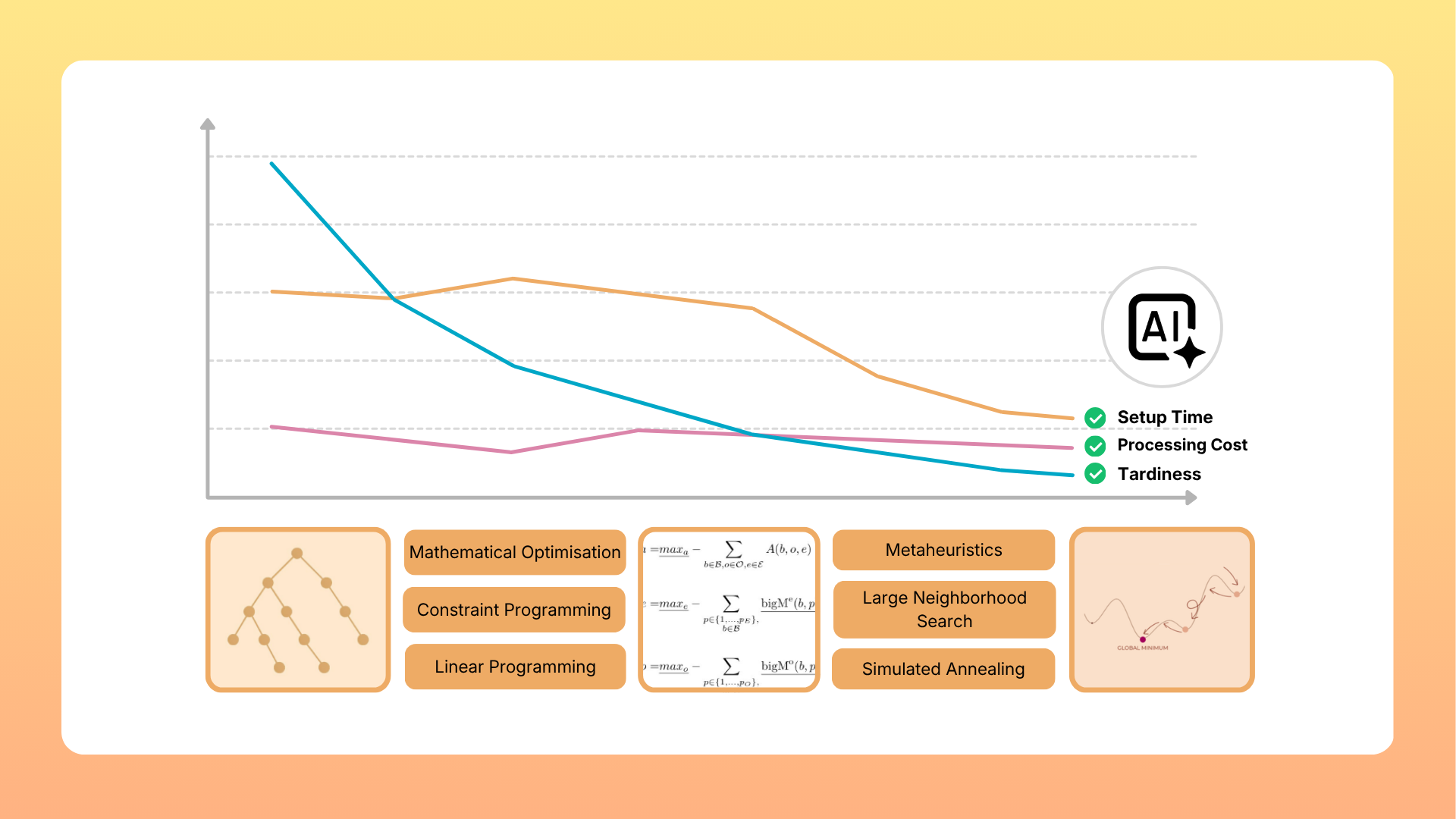
How AI supports your production planning
- constraints are highly interdependent
- objectives are conflicting
- variant diversity is high
- resources can be used in multiple alternative ways
- classical heuristics are not sufficient
- higher utilization of critical bottleneck resources
- additional reduction of setup and downtime
- optimized workforce and resource allocation
- better utilization of complex process structures
- faster response to dynamic changes
- economically more stable planning outcomes in complex scenarios
Benefit from AI where conventional planning reaches its limits
In a structured potential analysis, we assess whether your production setup can benefit from AI‑supported optimization methods and identify the economic impact that can realistically be achieved.
You will receive a well‑founded assessment of complexity, potential use cases, and implementation effort.