

























Food Production Scheduling
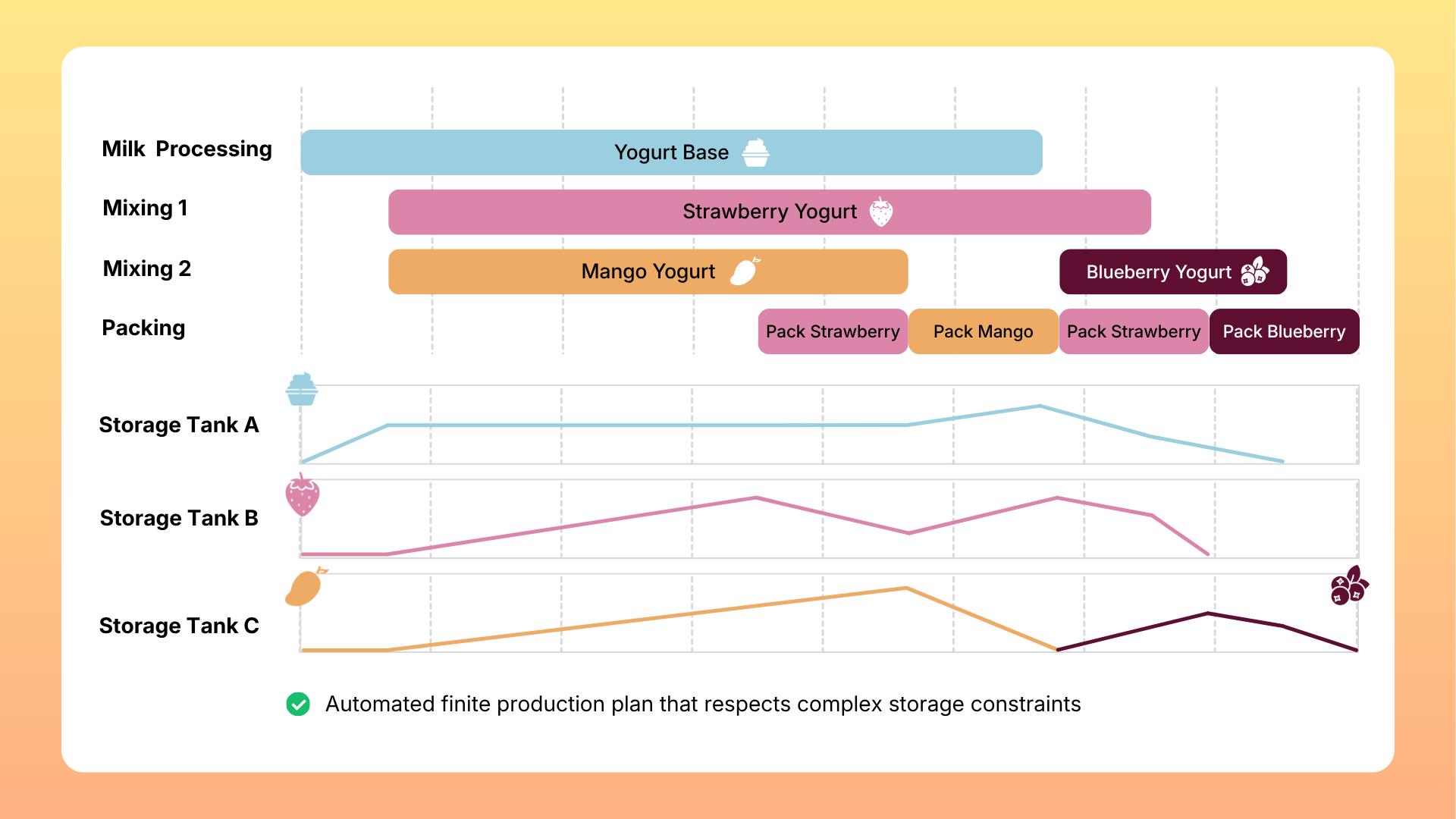
Food Production Scheduling optimises production processes in food manufacturing, where there are complex interdependencies between products, equipment, intermediate storage areas and production stages. The algorithm takes into account product and recipe changes, contamination risks, cleaning procedures, sequencing dependencies, intermediate storage areas, as well as plant and resource constraints, in order to generate optimal and feasible production plans. This results in more efficient product sequences and production campaigns, reduced cleaning and changeover costs, and better utilisation of existing capacity.
Production planning in the food industry is characterised by:

- Frequent product and formulation changes
- Hygiene and contamination restrictions
- Significant cleaning and changeover costs
- Limited interim storage capacity
- Closely interlinked production stages
Automated optimisation of food production scheduling:
- Production and packaging sequences
- Product and formula changes
- Cleaning processes
- Temporary storage allocation
- On-time delivery
In doing so, food-specific factors such as hygiene and contamination restrictions, material flows and limited temporary storage capacity are systematically taken into account in order to optimally coordinate production, temporary storage and packaging.
This becomes particularly critical in the case of:
- a wide variety of products and formulations
- product runs where allergens or contamination are a critical concern
- campaign production
- several linked production stages
- limited plant and interim storage capacity
Your benefits from Food Production Scheduling
Lower cleaning and setup effort
Higher equipment availability
Better resource utilisation
Higher planning reliability
More stable production campaigns
Reduced downtime
Who is food production scheduling particularly relevant for?
- Food industry
- Beverage industry
- Ultra-fresh food
- Compound feed industry
- Pet food industry
Easy Integration
Food Production Scheduling integrates seamlessly into existing:
- APS systems
- MES systems
- ERP systems
- custom planning solutions
The optimisation is implemented via standardized interfaces and enhances existing planning systems with targeted additional optimisation capabilities.
Relevant use cases:
- Sequence optimization
- Tank & Silo optimisation
- Setup time optimization
- Batch formation
What product-specific restrictions are currently influencing your production planning?
During a joint discussion, we will analyse your production logic and demonstrate how Food Production Scheduling specifically optimises complex product sequences, material flows and resource constraints.